
Hybrid Cloud vs Public Cloud: What Is the Difference?
Choosing between hybrid cloud and public cloud is not simply a matter of selecting the more modern-sounding option. The right model depends on how much control an organization needs, what type of data it handles, how variable its workload is and how much technical complexity its team can manage.
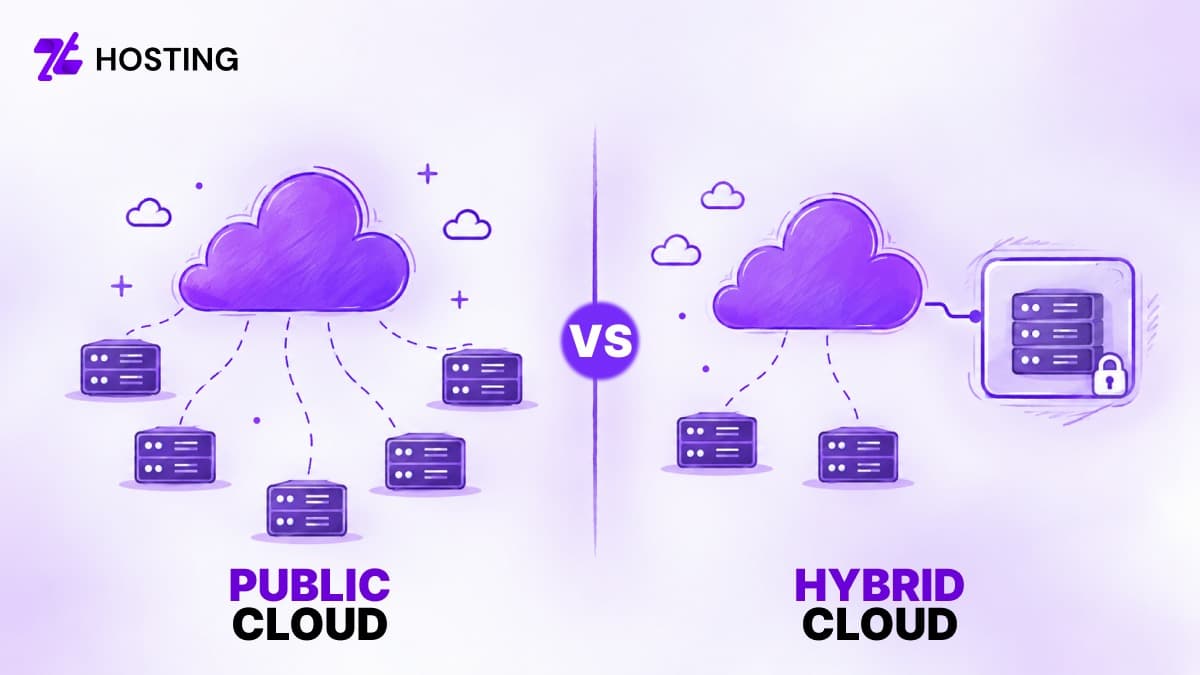
A public cloud uses infrastructure operated by a provider. A hybrid cloud combines private infrastructure with public-cloud resources so that different workloads can run in environments suited to their requirements. Understanding this distinction helps businesses avoid paying for complexity they do not need.
What Is a Public Cloud?
In a public cloud, the provider owns and manages the physical servers, storage and network equipment. Customers access virtual machines, managed databases, storage and other services through the internet or private connections. The underlying hardware is shared, but customer environments are logically isolated.
The main attraction is flexibility. A business can provision resources without purchasing a data centre or maintaining physical equipment. Public-cloud providers also offer automation, monitoring, backups and managed services, although the customer remains responsible for configuring many of them correctly.
What Is a Hybrid Cloud?
A hybrid cloud connects private infrastructure with public-cloud resources. Private infrastructure may be located in an organization’s own data centre or provided as a dedicated private environment. The public side can supply extra capacity, managed services or a place to run less sensitive workloads.
The connection between environments is important. A hybrid design is not simply two unrelated hosting accounts. It normally requires secure networking, identity management, monitoring and rules that determine which data or applications can move between environments.
Control and Flexibility
The central trade-off is often control versus operational flexibility. Private infrastructure gives an organization more direct control over configuration, hardware isolation and data location. Public cloud makes it easier to provision resources, experiment, scale services and use managed technologies.
Hybrid cloud attempts to combine these strengths, but it also means managing the relationship between two environments. Teams must understand both sides and ensure that applications can communicate reliably and securely.
Security and Compliance
Some organizations have regulatory, contractual or internal requirements that influence where data is stored and how it is accessed. A hybrid model may allow sensitive records to remain in a private environment while public cloud handles a website, analytics workload or temporary processing task.
This does not make hybrid cloud automatically secure. Access controls, encryption, patching, network segmentation, logging and backup procedures remain necessary. Public cloud can also be securely configured, but responsibility is divided between the provider and customer under a shared-responsibility model.
Cost and Complexity
Public cloud generally has lower upfront infrastructure costs because the organization does not buy physical hardware. Usage-based pricing can still become difficult to predict if resources, storage, data transfer or managed services grow unexpectedly.
Hybrid cloud may require investment in private equipment, connectivity, specialist skills and monitoring. It can be cost-effective for a specific workload, but it is rarely the simplest option. Small websites should not adopt a hybrid architecture merely because it appears more advanced.
Which Model Fits?
Public cloud is usually appropriate for websites, applications and teams that want flexible infrastructure without owning physical servers. Hybrid cloud may suit organizations with data-residency needs, existing private systems, specialized hardware or workloads that cannot move fully to a public environment.
Make the decision by mapping data, applications, traffic, compliance needs and staff responsibilities. Identify who will maintain each environment and how recovery will work if the connection between them fails.
A Practical Decision Checklist
Before selecting a model, document the data that must remain private, the services that need to scale, expected traffic, connectivity requirements, backup locations, security controls and total operating cost. Compare the complete solution rather than only the monthly hosting price.
For most small and medium websites, managed hosting, a VPS or a straightforward public-cloud setup is easier to operate. Hybrid cloud becomes reasonable when a clear business or technical requirement justifies its additional complexity.
Frequently Asked Questions
What is the difference between hybrid cloud and public cloud?
Public cloud uses infrastructure operated by a provider, while hybrid cloud combines public-cloud resources with private infrastructure connected for specific workloads or data.
Do small websites need hybrid cloud hosting?
Usually not. A managed hosting plan, VPS or public-cloud environment is simpler for most small and medium websites. Hybrid cloud is more relevant when compliance, data control or existing private systems require it.
Is hybrid cloud more secure than public cloud?
Not automatically. Hybrid cloud can provide more control over selected workloads, but security still depends on access controls, patching, encryption, monitoring and correct configuration.