
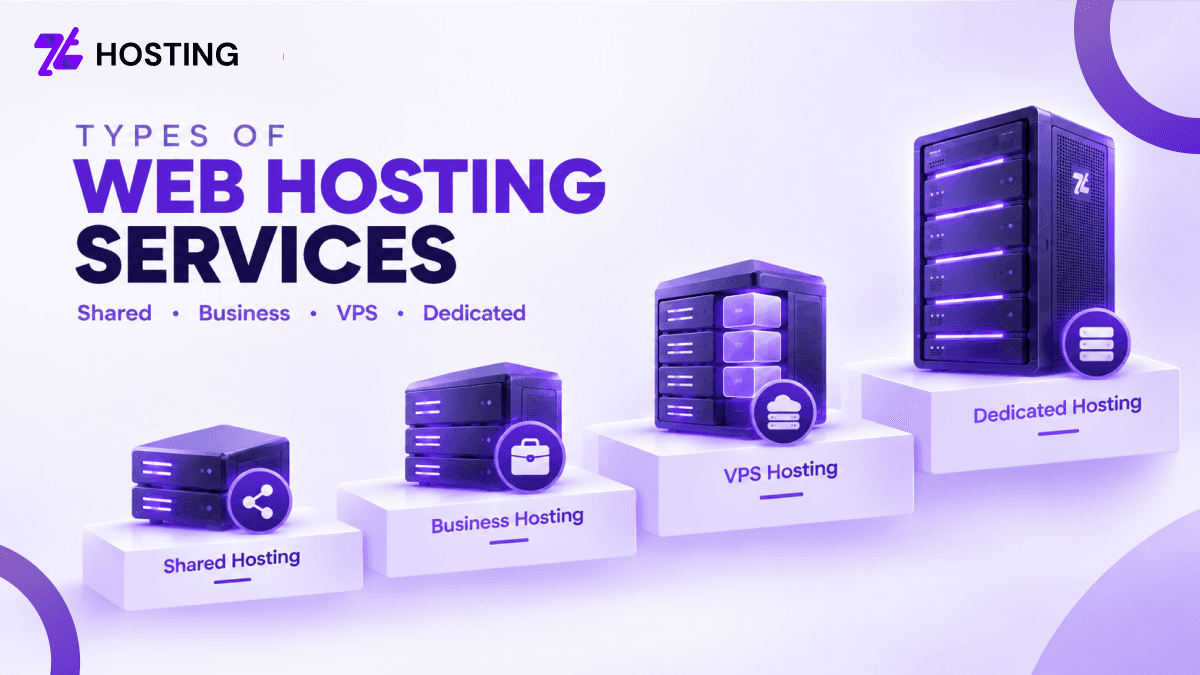
Types Of Web Hosting Services: Shared, Business, VPS & Dedicated Hosting
Choosing a hosting service is probably the most important task required before you launch your website. There are several types of web hosting services, each for a distinct purpose. In this article, we will discuss 4 types of web hosting. Every website needs different resources; thus it can be extremely confusing to choose a web hosting type and plan according to your needs. For example, a small blog and a high traffic business website do not demand the same hosting plan. As the world is advancing digitally, an online presence is essential and imperative in order to run whatever business you are in. Imagine your product is the best in the world but since you don’t have an online platform to showcase that product, it is highly unlikely that it will reach the height you imagined.
A study by Indonesian students examined how a website can help promote a business. The study concluded that a website surely helps a business with more reach and helps promote products and services to a wider audience. Now that we understand that having a website is not an option, but a necessity let’s dive deeper into which kind of hosting would work for you. In this guide we will focus on: Shared hosting, Business hosting, VPS hosting and Dedicated hosting.
Types Of Web Hosting
Hosting differs from plan to plan because of different levels of resources, performance and control. There are some hosting plans which use the same resources and servers for many websites while other plans offer more isolated resources. This directly affects performance and cost. The differences in these plans usually include storage, bandwidth, performance and price. Understanding these differences makes it easier to choose between the following hostings.
Shared hosting
To begin with, let’s discuss what is shared hosting. It simply means that multiple websites are hosted on a single physical server and the resources are divided among the users. Every website has its own space but the overall infrastructure is shared, hence the name shared hosting.
Shared web hosting makes web hosting affordable, cheap and gives customers all the required resources needed to run a website. It happens because the overall cost is distributed among all users. This way shared hosting becomes a suitable option for small business owners, bloggers, web developers and tech agencies. Moreover it is very easy to use because you don’t have to handle any major details so you do not need any technology related knowledge.
Now let’s pivot towards a few limitations of this type of hosting. Since the resources are shared, sometimes performance can become limited if it needs more storage. Moreover, it gives the user less control so they cannot really make changes on server level configurations. So for users who require more control and customization over their website, this may not be a suitable choice.
Business Hosting
Moving further to business web hosting. it is designed for those who need more resources and reliability than standard shared hosting but do not really want excessive control of a VPS or dedicated server. Business hosting is most suitable for growing businesses, eCommerce websites, and sites that require heavy traffic and workload.
Business hosting is essentially a step up from shared hosting. It has more CPU and Ram resources than basic shared hosting. Also, it gives better persformance and stability for websites while maintaning a managed environment so users do not have to handle complex server administration.
On the other hand, business hosting costs more than shared and even than may not be able to provide you with rootb level access and control. With all this and the xtra money, the resource limit still exits on these plans and if your website is growing everyday then eventually you would need to upgrade to VPS or dedicated hosting.
VPS Hosting
VPS hosting stands for Virtual Private Server hosting. It allows the user to have a more isolated virtual environment with allocated resources, giving them a greater control over the server configuration. However, the underlying server layers are still managed by the provider but you get your resources. This kind of web hosting especially suits growing websites and developers who require more scalability and customization on their sites.
It provides the customers with allocated server resources such as CPU/RAM. Overall provides much better performance stability and scalability. You can easily customize your website the way you like it and gain more control over your work.
With all that being said, it is more expensive than shared or VPS hosting and does require for the user to have more technical knowledge. If you get unmanaged VPS then it may require you to handle updates, security, backups and server configuration. Lastly, it shares the underlying physical server so it is not the same as a dedicated server.
Dedicated Hosting
Last but certainly not the least, let’s discuss dedicated hosting. It gives the client an entire server without sharing it with other users. All resources of that server including CPU, RAM, and storage are reserved for that customer. This type of hosting is best suited for high traffic websites, large eCommerce stores, enterprises and business that need maximum control and customizations over their operations.
A user with managed dedicated server gets full control and resources with customizations to their website. It gives robust performance to heavy workload sites and better isolated resources from other users. It works amazingly well with high traffic websites and gives maximum flexibility for security and server configurations.
In contrast, it costs the highest among all 4 types of web hosting. It requires stronger technical knowledge more so if the hosting is unmanaged. The overall server maintenance and updates may require experienced administrations.
Conclusion
All in all, grasping the core features of different types of web hosting services really helps one to understand what kind of hosting solution will best suit them. Shared hosting is best as an affordable option for small websites while business hosting provides additional resources for growing businesses. VPS offers more control and isolated resources, on the other hand dedicated hosting is designed for websites that need maximum control and server configurations.
There is no single type of hosting for every website. It all comes down to your website traffic, requirements and how much control you like on your site. So, before you select a plan, make sure you understand the needs of your website so you can get the right hosting from the beginning. This way you can control and maintain your website better from the start!
FAQs
1. What are the main types of web hosting services?
There are 4 main types of hosting services including: shared, business, VPS and dedicated hosting.
2. Which type of hosting is best for beginners?
Shared hosting is most suitable for beginners as it is affordable and easy to manage.
3. When should I upgrade from shared to VPS hosting?
You should consider upgrading when your website needs more resources, scalability and greater server control.
4. Is dedicated hosting better than VPS hosting?
Dedicated hosting offers more control and full server resources while VPS is more suitable and affordable for websites that do not need an entire physical server.